 WinSPIRE: Science in the News
Childhood is supposed to become a place you return to with a smile. The smell of crayons, the quick footsteps as we run to recess, the joy of dessert after dinner; these are some of the experiences people may reminisce about when reflecting on their childhoods. Unfortunately, many people remember loud footsteps, arguing from across the hall, and the grumbling of an empty belly. Memories may be subconsciously left in the back of the mind to be ignored, but these memories aren’t easily forgotten. In fact, they change you mentally and chemically, with long-reaching impacts on behavior, mental health, and physical disease.
Adverse Childhood Experiences (ACEs) are potentially traumatic events that occur in someone’s life from birth to late adolescence. There are numerous forms of ACEs, including but not limited to: sexual abuse, physical abuse, and neglect. Other adverse experiences may involve financial strain or an unstable home environment. In Europe and internationally, community surveys have shown high rates of physical and emotional neglect (34.7%) and abuse (52%) as well as sexual abuse (9.6%) in people’s childhood homes, but rates are likely higher when accounting for unreported cases. ACEs are prevalent in high schoolers and uniquely impact adolescents due to the major physical, neurobiological, and psychological changes they experience. Shifting hormones play a key role in these changes.
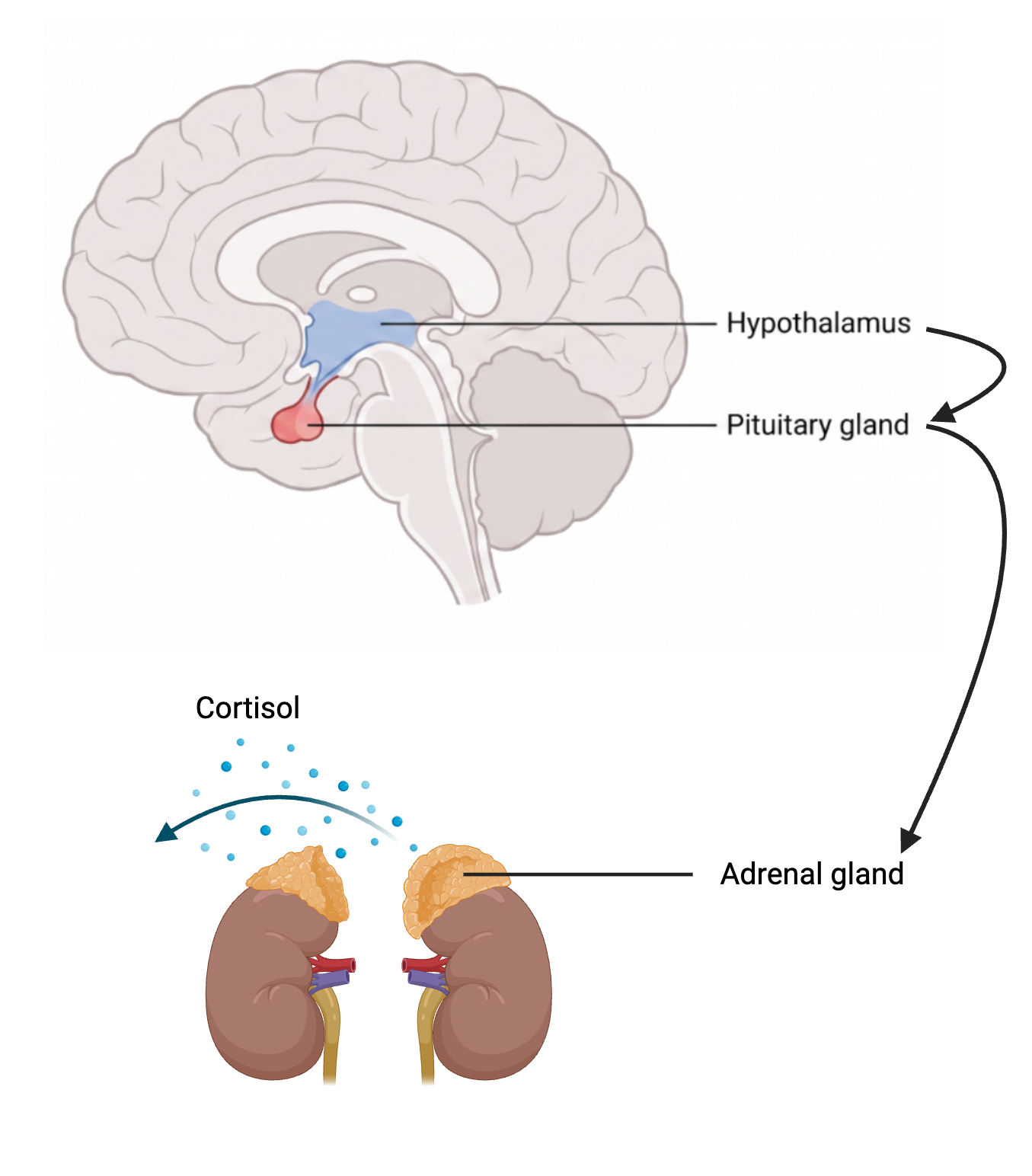
Hormones are the chemical messengers that activate and regulate various functions in the body, such as metabolism, mood, growth, and development. These messengers connect to cell receptors, providing signals that trigger downstream processes. Think of this as the “ding” of a notification leading you to check your phone. The tissues, organs, and glands that produce, store, regulate, and release hormones collectively make up our endocrine systems. When looking at the impact of ACEs on health and behavior, some major players include the hypothalamus, the pituitary gland, and the adrenal glands. These tissues, when cooperating together to respond to stressful stimuli, make up the hypothalamic-pituitary-adrenal (HPA) axis. Specifically, when the body is under stress, the hypothalamus sends a signal to the pituitary gland, which then signals to the adrenal glands (located on top of the kidneys) to release the stress hormone cortisol (Figure 1). This cascade of events helps the body respond and adapt to stressors. These key tissues also help to produce hormones such as oxytocin and testosterone, which interact with cortisol to influence the stress response. However, this interplay can get thrown out of balance in people who are exposed to ACEs.
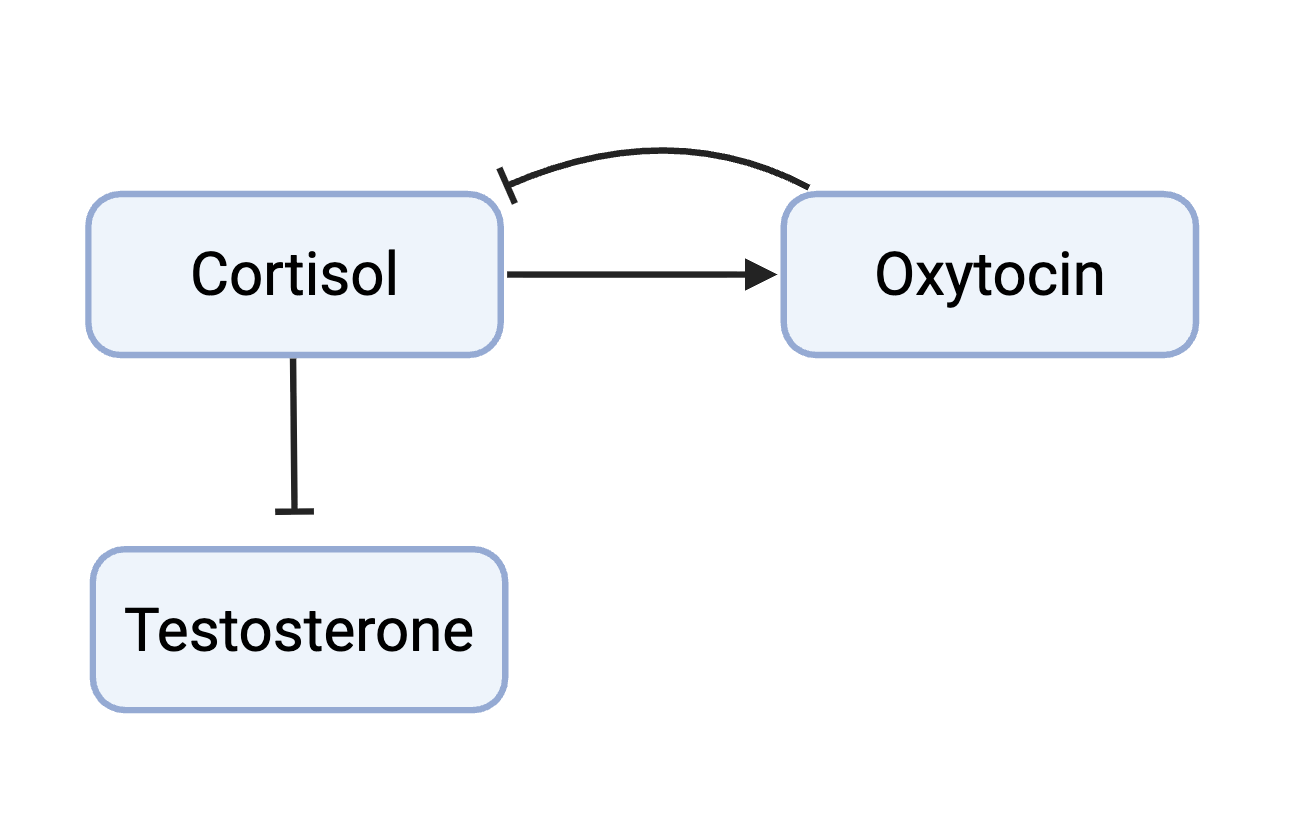
You may have heard of oxytocin, or the “love hormone.” While this is a catchy way to think of oxytocin’s role in the body, its function is much more complicated. When a person is in an alert state, oxytocin release leads to lower cortisol, helping to regulate the nervous system (Figure 2). However, oxytocin also acts as an emotional amplifier, turning up the volume on whatever vibe a person is experiencing. For individuals experiencing ACEs, their environment is frequently perceived as threatening. In these high-stress contexts, instead of promoting social bonding, oxytocin can amplify negative social cues, heightening survival instincts and triggering defensiveness or aggression. When this happens, oxytocin shifts from a hormone that fosters connection into a hyperactive tool for danger detection.
The stress response can also be affected by the presence of the hormone testosterone. Testosterone increases in both males and females as they undergo puberty. In a healthy adult system, testosterone and cortisol operate through a biological back and forth: when high stress pumps up cortisol, testosterone usually gets benched so the body can focus purely on survival (Figure 2). During adolescence, though, this relationship flips; testosterone and cortisol tend to rise together instead of trading off, a pattern unique to this period of development.
This entire system gets further thrown out of whack in people experiencing ACEs. Because their environment is constantly perceived as threatening, their stress engine is locked in the “ON” position, increasing cortisol and oxytocin. This system runs hot during early traumatic events before settling into a blunted baseline by adulthood, resulting in lower-than-average cortisol and oxytocin patterns. Meanwhile, a high testosterone-to-cortisol ratio has been associated with aggressive behavior, suggesting that in some ACE-exposed individuals, aggression may increase, not because of elevated testosterone levels, but because these levels are high relative to the blunted cortisol response. In addition to contributing to potentially aggressive behavior, these hormonal imbalances put the ACE-exposed individual at a higher risk of disease.
Hormones are only one part of the body’s complex response to trauma, but they demonstrate the strong link between a person’s early experiences and their physical health. They tell us that the heavy footsteps and echoing arguments of a chaotic home do not simply vanish when a child grows up, but leave a lasting physical imprint. This reality serves as a vital warning to parents and caregivers. Among other factors, disciplinary practices during childhood serve as a foundational blueprint for long-term health outcomes. Research indicates that punitive strategies relying on high stress, fear, or emotional neglect extend beyond immediate behavioral modification. Harsh disciplinary measures as well as overall household environment, social environment, and treatment across settings can alter neurodevelopment and immune system functioning, increasing the statistical risk for chronic physical illnesses and long-term mental health conditions. Parents and childhood environments hold profound power to shape not only how children behave today, but how their bodies and minds function decades from now. To protect a child’s future, we must remember that the body is always keeping score of how it was treated.
Written by: Meron Mekonen and Julissa Rodriguez Santos
Edited by: Lauren Griffith, Katie Holmes, and Hazel Milla