 WinSPIRE: Science in the News
“I cannot rationally pinpoint any specific reason for doing this,” the gunman Charles Whitman wrote in a note after murdering his mother and wife on August 1, 1966. Later that same day, the gunman climbed the University of Texas tower and carried out a deadly attack on the people below. He was killed by police officers trying to stop him. He wrote numerous letters, including one asking for an autopsy after his death.
During Charles Whitman’s autopsy, Dr. Coleman de Chenar found a brain tumor called a glioblastoma in his temporal lobe, a part of the brain that handles sensory processing, memory, language, and emotions. A glioblastoma is a fast-growing and life-threatening tumor that spreads to neighboring regions in the brain, making it very difficult to treat or remove. The autopsy further revealed that Whitman’s tumor was compressing his amygdala, a tiny, almond-shaped group of brain cells located within the temporal lobe.
The amygdala plays a central role in threat detection, survival instincts, and processing emotions like fear. It does so by communicating with other parts of the brain to detect and assess threats. This process starts with your sensory organs, such as your eyes. These organs send signals to your brain’s relay station, called the thalamus, which then sends information to the amygdala. The amygdala acts like your body’s smoke detector; when it senses a threat, it sets off the alarm to protect you. It does this by signaling to the brain’s coordinating center, the hypothalamus, triggering the body’s automatic response to danger, called the “fight-or-flight” response. During this response, hormones such as adrenaline are released to help you either face the danger (fight) or run to safety (flight). Threat detection and response occur through different pathways in the brain: the low road, which helps the body respond immediately to a threat, and the high road, which produces a more delayed, calculated response. The amygdala plays a vital role in both of these pathways.
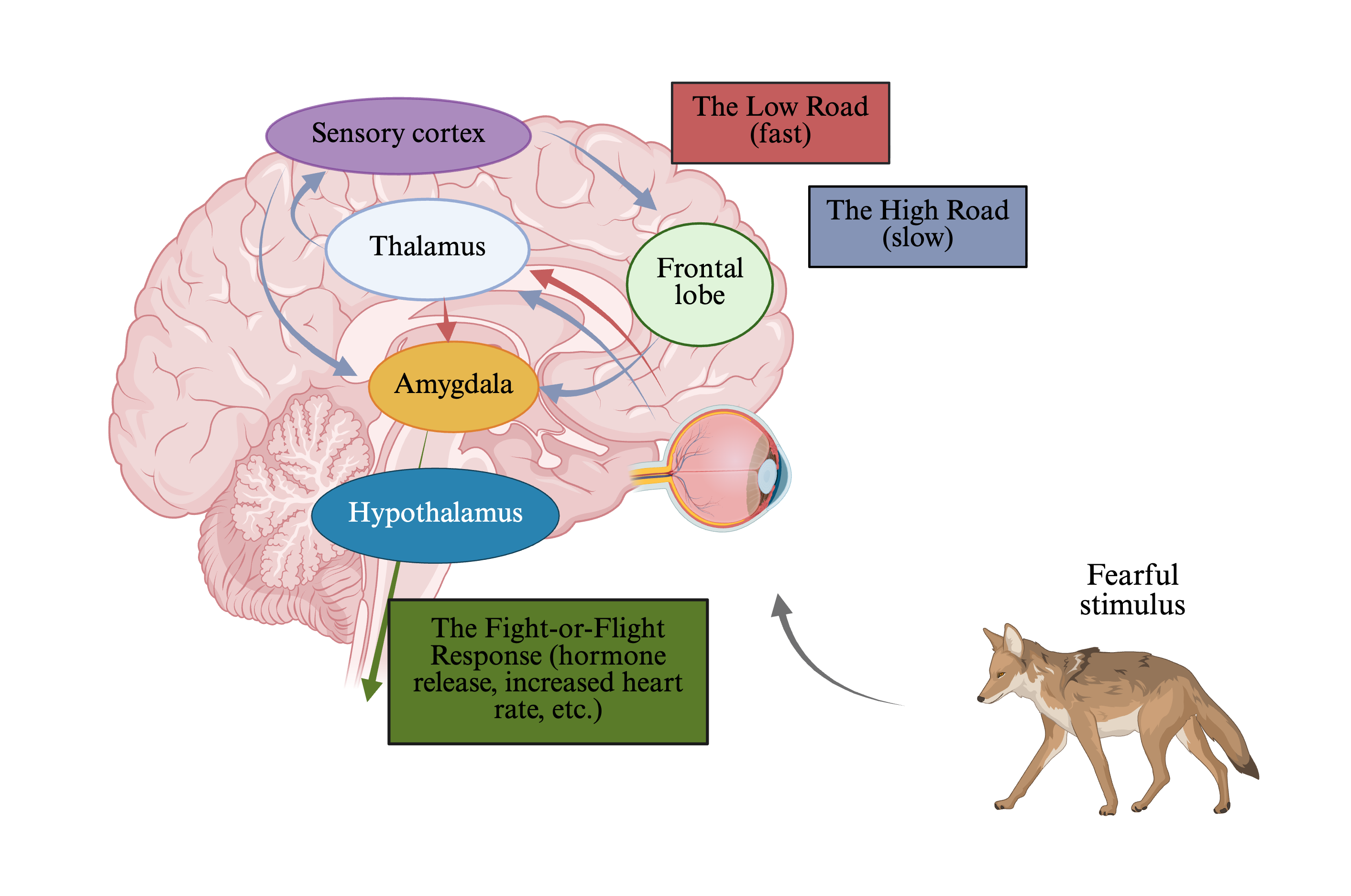
When affecting the amygdala of the brain, tumors can lead to intense mood swings and emotional instability. This could be one of the many reasons why Whitman carried out his violent attacks. A healthy amygdala will respond to stimuli predictably, like a well-trained guard dog, balancing reactions and regulating emotions to help you act on protective instincts and make adaptive decisions. Disruptions to the amygdala will affect both the low and high road pathways, however, altering how the body experiences and responds to fearful stimuli. This can manifest in several ways, including reduced inhibition, flat emotional responses, and increased aggression and impulsivity. Several experiments have linked features like reduced volume and increased activity of the amygdala to hostile behavior and emotional reactivity. Furthermore, agitation, impaired decision-making, and extreme headaches associated with the tumor possibly amplified Whitman’s emotional responses, making it difficult for him to control his actions.
An individual who has disrupted function of the amygdala such as Whitman simply may not have the cognitive capacity to control their behavior. However, many medical professionals debate whether or not this should be the sole reason attached to his actions. Notably, this was not Whitman’s first bout with violence. He admitted to domestic violence and shared that his father was extremely abusive, which may have contributed to his violent actions. He also experienced many other health complications and traumatic events, including traumatic brain injury, prior to the development of his tumor. Additionally, although the tumor on Whitman’s amygdala may have impacted his behavior, the doctor who autopsied Whitman’s brain, Dr. Coleman de Chenar, said the tumor wasn’t in a region of the brain that would likely affect his personality. This raises several questions: Were Whitman’s violent actions the result of his tumor, or were they a result of other factors, such as traumatic brain injury or personality? Were environmental factors, such as his father’s abusive behavior, also major contributors to his behavior? How much control did he have over his actions?
It is also worth noting the substantial level of clarity that allowed Whitman to articulate his mental state prior to the attack. Whitman wrote, “I don’t quite understand what is compelling me to type this note.” He then continued to write, “I’ve been having fears and violent impulses.” Whitman was clearly experiencing very intense and severe urges, and he never seemed to comprehend why he felt that way. However, Whitman’s notes indicate that he had a plan that he thought through and executed. This evokes several questions: Do individuals with neurological complications lack the capacity to make decisions even if they are aware of what they are doing? Should individuals who are struggling mentally due to medical complications be held to the same level of responsibility as a healthy individual? This debate has been going on for decades and may be informed by neuroscience. It’s worth noting, however, that most people who are experiencing neurological issues or mental illness do not engage in violent behavior. And when coupled with a violent background, a rough upbringing, repeated brain injury, and possible genetic factors, it is clear that neurological complications are only the tip of the iceberg, representing just one of the many biological and environmental factors which lead people such as Whitman to violence.
Written by: Meranda Dwe, Maryori Garcia Mas, and Salma Ittidir
Edited by: Lauren Griffith, Katie Holmes, and Hazel Milla