 Rachel Burdorf
“Oh, wow,” is not what you want to hear from the nurse at the doctor’s office. You especially don’t want them to follow that up with, “I’ve never seen that before.”
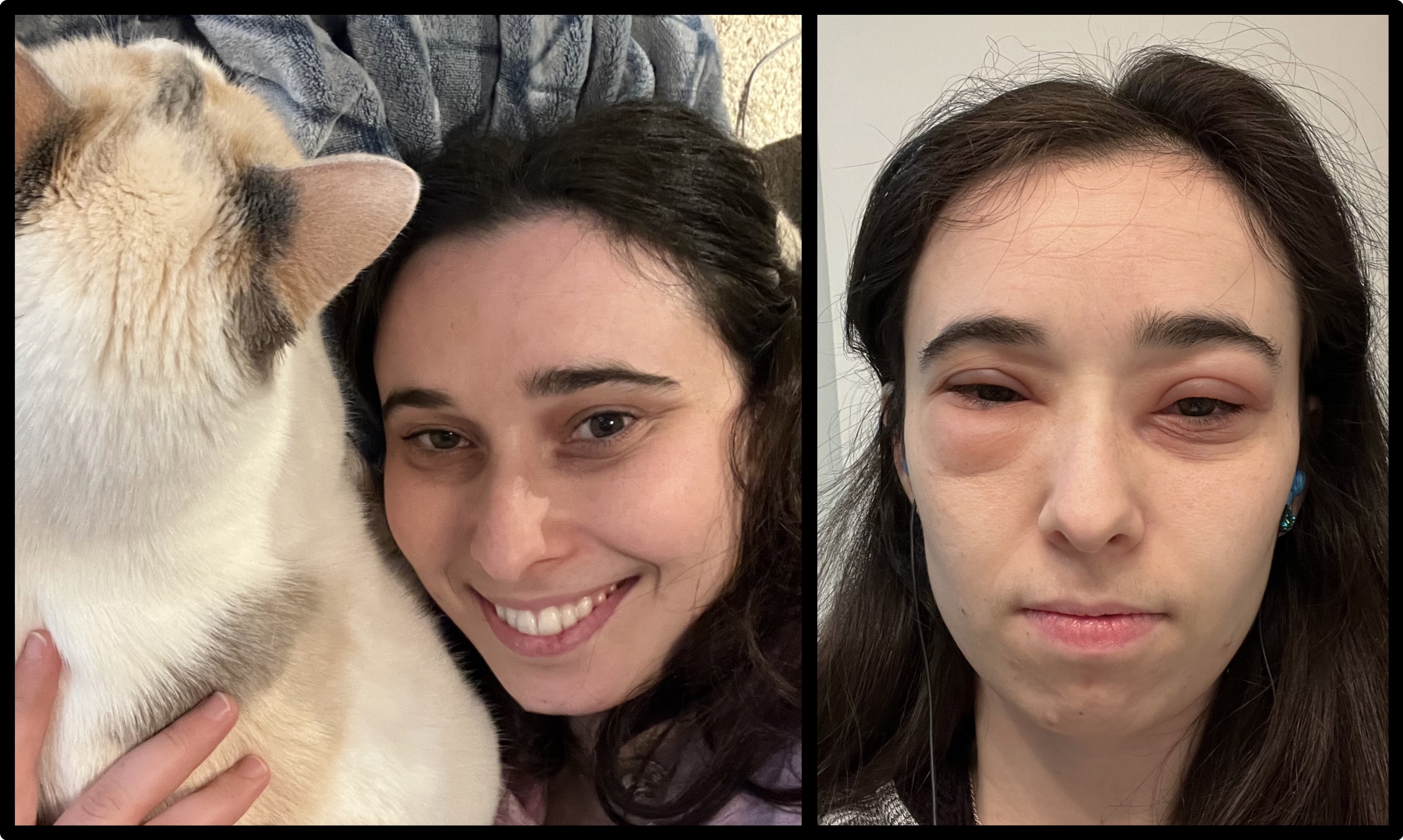
This was in response to a picture of my own face, which I had taken the week before when my eyelids swelled up like asymmetrical golf balls. It looked a lot like the picture to the right.
By the time of that doctor’s visit, my eyelids had been unpredictably swelling up every few weeks for about a year. I methodically went through every possible trigger I could think of and ruled out all of them. No doctor I saw had an explanation until I was able to get an appointment with an allergy specialist. To my intense relief, when she heard my explanation she knew what it was.
The full name of the condition is a whopper: Chronic Spontaneous Urticaria and Angioedema. For brevity’s sake, it’s often abbreviated to ‘CSU’ in research papers. I’ve broken it down below:

The name is a direct description of the symptoms: soft tissue swelling and hives. In my case, the swelling only happened on my eyelids. It wasn’t painful or sore, just unnerving. For other people, the swelling can happen on their lips or hands. The other half of the condition is hives, which are defined as a skin rash with a raised bumpy texture and defined edges. The individual bumps or welts can vary in size from smaller than a pinky nail to bigger than a hand, and can either be reddish or match the skin tone. Hives are usually itchy, but not always. Curiously, despite having CSU, I have never gotten hives.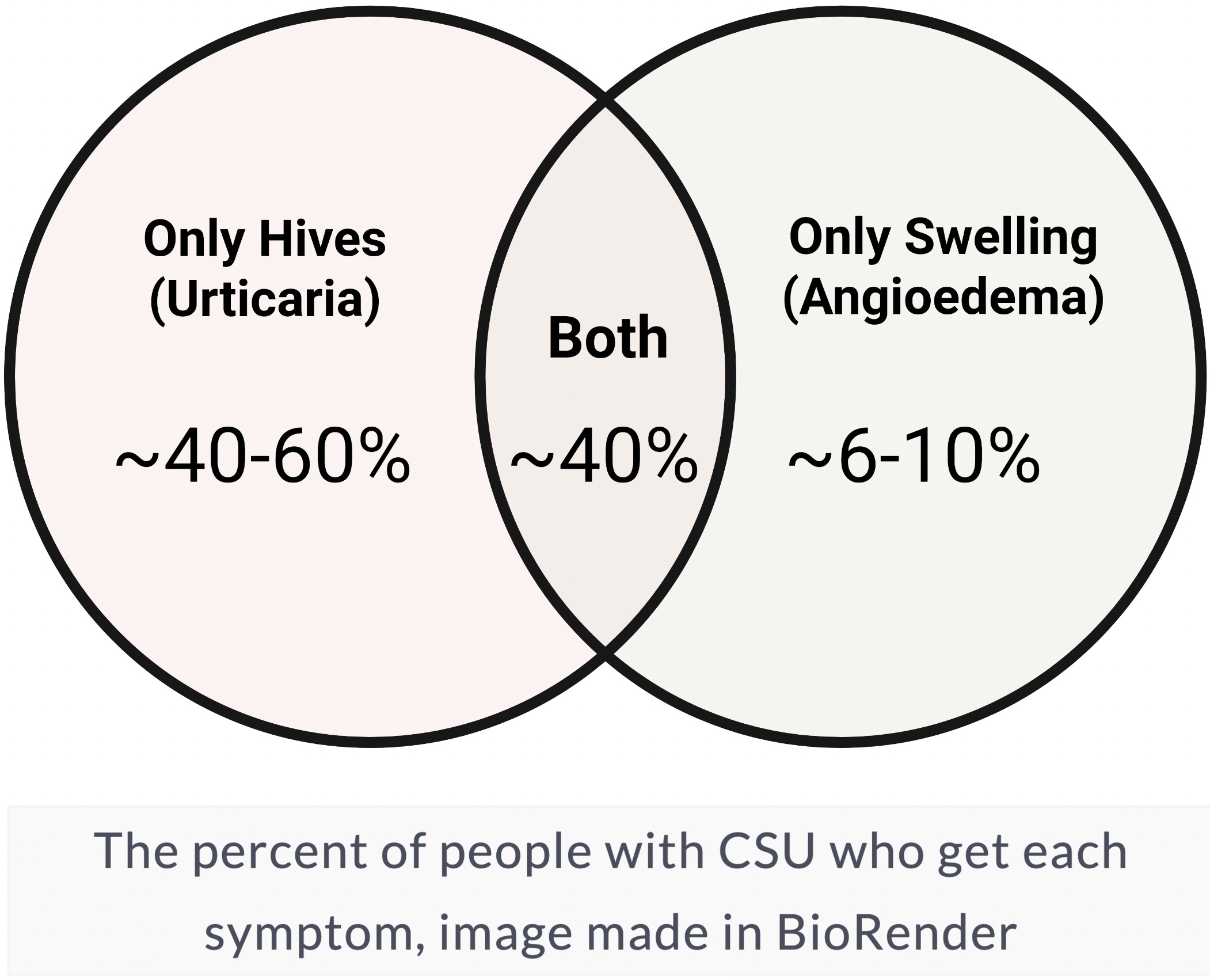
That’s uncommon, but CSU is known to vary in the symptoms people get: Roughly 40% get both hives and swelling, around 40-60% get only hives, and around 6-10% get only swelling, like me.
The key driver of this condition is an
important immune cell type called a mast cell. Mast cells are first line responders in your body, detecting outside threats like viruses and raising immune responses against them. When they encounter threats, activated mast cells release histamine and other inflammatory signals, which support a rapid local immune response by increasing local swelling and summoning other immune cells to the area. Mast cells can also directly cause allergic responses when they mistakenly identify something like pollen or peanuts as a threat, and mount an immune response against it.
CSU symptoms work through this same pathway, and resemble an exaggerated version of this same response. But CSU is not a response to an external threat. CSU actually has no external trigger. In people with CSU, the system misfires in a different way: the body accidentally causes mast cells to strongly activate against nothing. The call is coming from inside the house, so to speak. This causes pointless and excessive hives and swelling (hives if the activated mast cells are in upper skin layers, swelling if they are in deeper skin layers). The chart below shows the difference between the activation mechanisms.
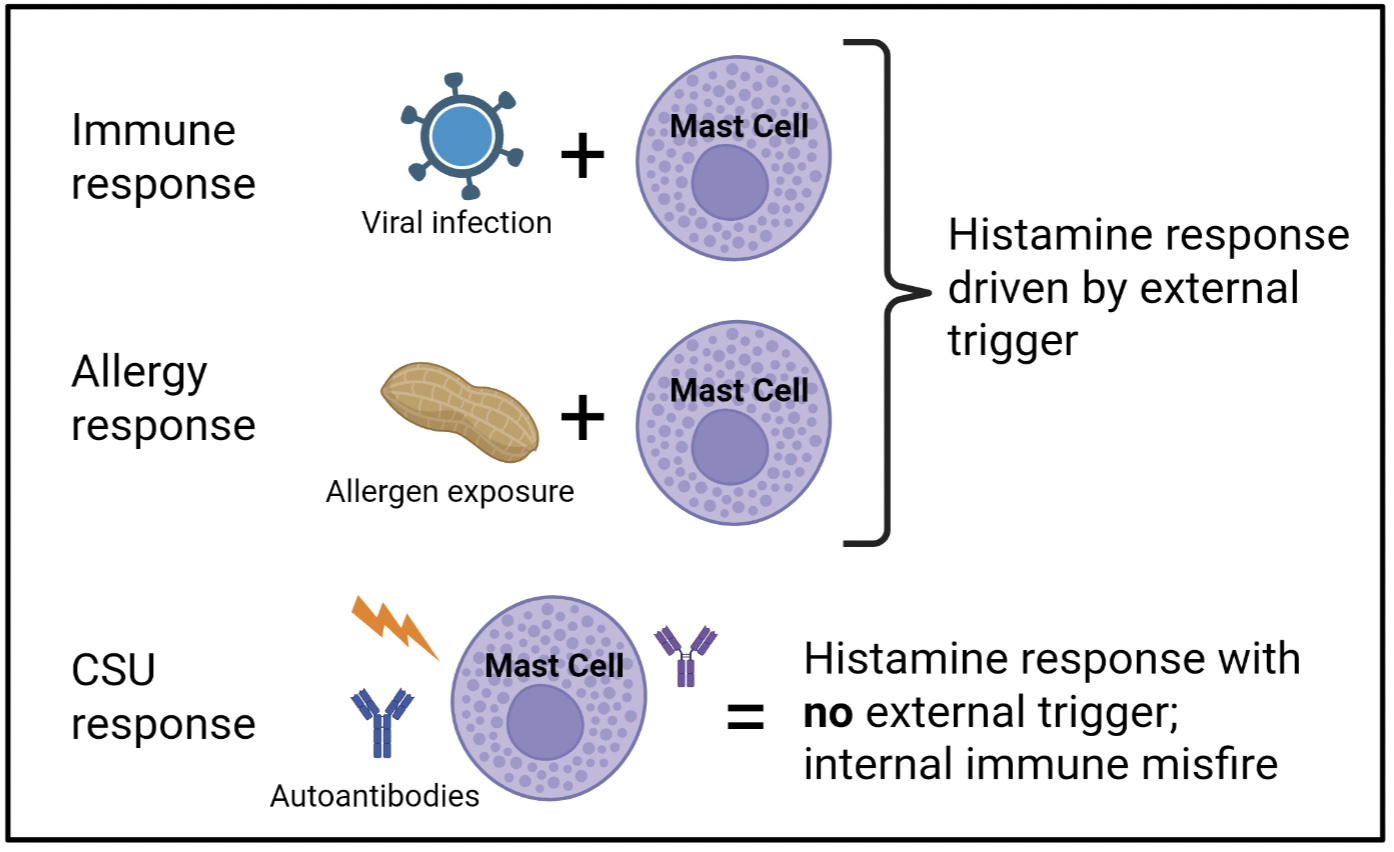
Often, CSU mast cell activation is autoimmune, caused by the body making antibodies which can grab the body’s own normal proteins and use them to activate mast cell signal receptors. Normally, the body’s safeguards destroy harmful antibodies like this (called autoantibodies, i.e. self-targeting antibodies) long before they’re ever deployed. It’s not known why these antibodies make it through in people with CSU. This activation route accounts for about half of CSU cases. In other cases, CSU isn’t driven by autoantibodies, but people have higher background inflammation levels, priming their Mast cells to be 100x more sensitive to inflammatory signals than they should be. This sensitivity is notably similar to MCAS (Mast Cell Activation Syndrome), in which mast cells are also oversensitive and have strong, erratic reactions to normal stimuli. The difference is that CSU is almost always limited to the skin and highly localized, while MCAS is a systemic condition which affects multiple organ systems. In other cases of CSU, mast cell activation is likely driven by misfires in other immune cells or pathways. Overall, a lot more research is needed to understand why these mast cells activate inappropriately in people with CSU.
In the US, it is estimated that 0.11%-0.78% of people have CSU, which is between roughly 1 and 8 per 1,000 people. CSU can start in childhood or appear in adulthood. During my appointment, the allergy specialist told me that many adults who are diagnosed with CSU recall having especially sensitive skin as children, which I definitely did. I also have Dermatographia, a.k.a ‘skin writing’, which 70% of people with CSU have. Dermatographia is also driven by sensitive mast cells in upper skin layers, which respond to firm scratching or rubbing by raising lingering red marks or welts tracing the exact path of the scratch. CSU is also twice as common in women compared to men, similar to other autoimmune disease statistics. People with CSU are much likelier than normal to have other autoimmune diseases, especially autoimmune thyroid disease. More research is needed to straighten out the tangled web of immune signals that govern why and how these relationships happen.
But despite this complexity, the treatment for CSU is often straightforward. Regardless of why these mast cells are releasing histamines, blocking the histamine from doing its job often solves the whole problem. Anti-allergy antihistamine medications like Zyrtec or Claritin can often block CSU symptoms just as well as they block allergies. For some people, however, these medications don’t do enough, and they need stronger, more targeted anti-inflammatory or immunosuppressant treatments that block symptoms by a different mechanism. Overall, if you have symptoms like the ones described in this article, it’s important to talk to a doctor who knows about allergy and immune pathways. They can help you determine if you have CSU or a different condition with overlapping symptoms (there are several), and they can help you navigate your options and find a safe and effective treatment.
I can vouch for that. Since my appointment with the allergy specialist in 2022, I have taken a cheap generic anti-allergy medicine every morning. And my eyes haven’t swelled like that ever since. Knowledge truly is power.
Written by: Rachel M. Burdorf
Edited by: Priscila Santa Rosa