 Pari Dhayagude
Tennis is one of the fastest sports in the world. By the time a 120mph tennis serve crosses the court, the returning player has had less than half a second to register, react to, and return the ball. Visual processing, decision-making, and motor initiation all introduce delays, so information about the ball is somewhat out of date by the time it contributes to an action. Reflexes play a big part, but the ball will fly right past you if you’re only reacting to its flight. Luckily, your brain compensates by projecting moving objects forward to where they’re likely to be—which is a polite way of saying it guesses. So how do professional tennis players do this routinely with accuracy and make it look effortless while doing so?
Anticipation begins before the ball travels.
Professional tennis players have solved this seemingly impossible task by starting their reaction earlier but mostly without realizing it. While this may sound easy at first, starting earlier actually means mastering the art of anticipation, which includes perception, memory, attention, and motor planning. Much of this process has happened before the ball has even left the opponent’s racket. While it takes thousands of hours of practice and matches to master this, professional tennis players develop the ability to read subtle kinematic cues in their opponent’s movement, such as the racket angle, feet position, ball toss, and shoulder rotation. These cues provide information about where the serve will likely land before the ball’s trajectory is fully seen. In a sense, players predict the serve first from the opponent’s body and again from the ball’s movement in the air.
The brain is a prediction machine!
This anticipation relies on several brain regions working together. The cerebellum, a densely folded structure tucked beneath the back of the brain, plays an important role in predicting and coordinating movement. Literally translating to “the little brain”, the cerebellum generates internal models of how the body and external world behave in real time, allowing movements to be adjusted before conscious awareness catches up. While this helps us understand what is happening before the ball leaves the racket, players also have to predict the ball’s trajectory once it is in motion. Motion-sensitive areas of the visual cortex (MT/V5) help process the ball’s direction and speed, allowing the brain to predict where the ball will be to make up for the lapse in time between seeing the ball and registering where in space it is. This information travels through the dorsal stream to the posterior parietal cortex, where the ball’s position is integrated with information about the player’s body and spatial location on court. Following this, premotor regions and the supplementary motor area prepare and sequentially organize subsequent movements. Finally, the primary motor cortex recruits muscles involved in the player’s footwork, body rotation, shoulder movement, and ultimately the swing.
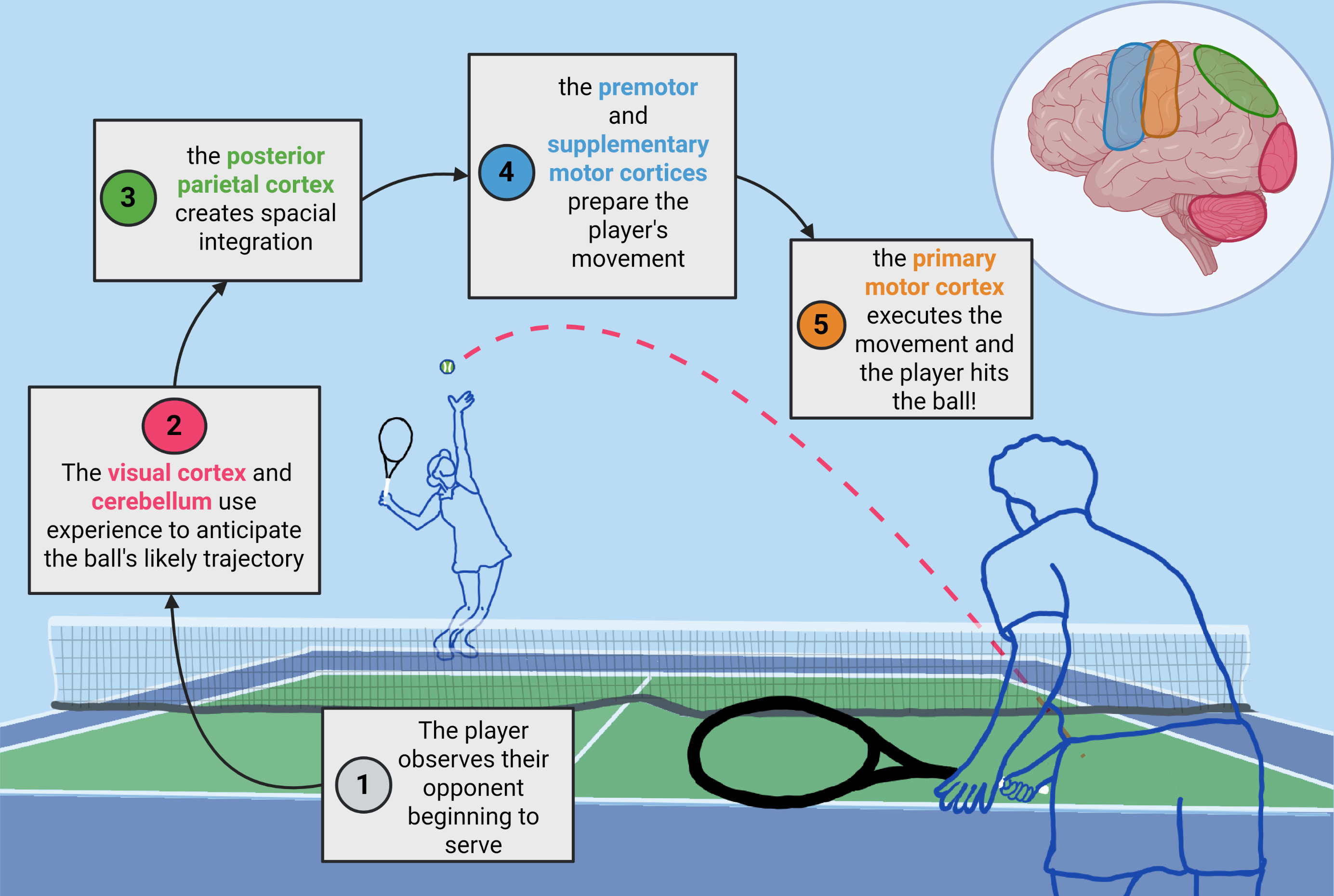
These predictions are not separate from movement; they happen simultaneously, shaping the player’s footwork and position. As the server begins their motion, the returning player may shift their weight or start a step before the ball’s final direction is completely clear. Seeing the opponent’s movement is directly connected to preparing one’s own movement, known as perception-action coupling.
To be clear, your brain doesn’t actually know the future. Instead, the brain is a fast, well-trained guesser that builds predictions from visual motion, memory, attention, and thousands of hours of experience, then updates them as new information arrives. What may look like a speedy reflex is instead a coordinated neural process in which your brain starts preparing for the most likely future while ‘you’ are still catching up to the present. In other words, your brain is right on time, but your awareness is fashionably late.
Peer Edited By: Emily Hand
Illustrated By: Claire Miller