 Claire Miller
The grass is green, the sun will rise tomorrow, and swans are black and white. These are things that we generally accept as facts. We rely on such knowledge every day to navigate and understand the world. Through hypothesis testing, experimentation, and evidence-based reasoning, science seeks to transform observations into increasingly reliable explanations of the natural world. But can it ever actually prove them?
David Hume was an 18th century Scottish philosopher who challenged our confidence in facts. He noted that many of our beliefs are based on recurring patterns in nature, and although those patterns have remained consistent thus far, they may not remain that way.
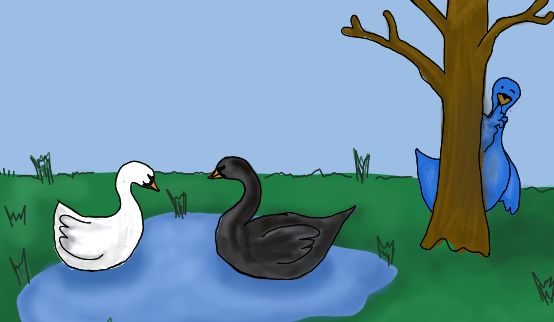
For example, if every swan we have ever observed were black and white, we would naturally conclude that all swans are black and white. However, that conclusion rests entirely on past experience. What if there is a blue swan somewhere that no one has ever seen before? This single observation would be enough to disprove our conclusion. Thus, Hume argued that inductive claims can never be proven with certainty; they can only be supported by the evidence currently available. However, modern science extends far beyond what can be observed with the naked eye. By examining the underlying mechanisms that produce observable traits, scientists can test not only whether two events occur together, but also why they occur.
Today, suppose we are swan geneticists at the Swan Institute, and we notice that every swan that expresses the creatively named “black-feather gene” has black feathers, and every white swan does not. Hume would argue that this does not necessarily mean that the “black-feather gene” is the cause of black feathers, though the fact remains true.
By observing this, we have identified a correlation. Every swan expressing the “black-feather gene” has black feathers. But, a phrase forever engrained in our brains as PhD students in swan genetics comes to mind…“correlation does not necessarily prove causation.”
We have yet to prove that the so-called “black-feather gene” is the reason that these swans have black feathers. We have only shown through our experiences and observations that the “black-feather gene” is expressed in black-feathered swans… but does that prove it?
Hume, along with most scientists, would say no. Hume posits that repeatedly observing two events together does not necessarily prove causation.
While it’s true that we have yet to prove causation, scientific technology has come a long way since Hume’s time. In the 1700s, Hume would simply have had to accept that he could never know whether the “black-feather gene” causes black feathers. Three hundred years later, however, we have tools such as genetic manipulation that allow us to move beyond simple observation and experimentally test whether the “black-feather gene” is the cause of black feathers.
If we receive approval from the swan ethics committee, we are able to genetically manipulate the genome of a swan to delete the “black-feather gene”. And we’ll throw in a rescue experimental group, where we delete the “black-feather gene” and then put it back into the genome, to please reviewer 2.
With modern science, we are able to empirically test the fact that “‘the black-feather gene’” is the cause of black feathers – beyond just the plain observation.
Suppose that knocking out the black-feather gene leads to a white swan, and when we rescue the “black-feather gene”, the swan has black feathers again.
Based on this experiment, we have proven causation…Or have we?
Admittedly, our experiment has given us a much more convincing argument that the “black-feather gene” is the cause of swans being born with black feathers. However, we are still guilty of applying our past experiences to an unobserved case in our continued belief in the fact that “the black-feather gene causes black feathers in swans.”
Here at the Swan Institute, we perform experiments on a species of swan native to Australia. However, what if there is a Canadian swan species whose black feathers arise through an entirely different genetic mechanism? We cannot rule out the possibility that somewhere, under different circumstances, black feathers arise through a different mechanism than the one we have observed.
So if we can never actually assume that any fact is true, then we will never be able to prove anything, and scientific knowledge cannot be trusted.
Unlike swans, the answer is not so black and white.
Hume may be right that we will never be able to establish something with absolute certainty for all time and all possible circumstances. Even our strongest scientific conclusions are based on our past experiences, and there is always the possibility that a future observation will force us to revise what we thought we knew.
Yet this is not a weakness of science, and it certainly does not mean that knowledge discovered with science is wrong. Science continuously tests its own ideas, searching for evidence that might prove those ideas wrong. Theories that survive these challenges become increasingly reliable, not because they have been proven beyond all doubt, but because they have repeatedly survived attempts to disprove them.
So perhaps the goal of science is not to discover and prove unquestionable truths, but to build the best explanations possible with the evidence available. Our understanding of the world is always incomplete, always subject to revision, and always improving. If one day we discover a Canadian swan whose black feathers are controlled by an entirely different gene, science will not have failed. Science will have done exactly what it was designed to do and will build on the knowledge that it previously led us to.
The grass is still green, the sun will rise tomorrow, and every swan is still black and white. As scientists, we simply remain open to the possibility that somewhere, beyond our current observations, a blue swan could be waiting to be found.
Peer Edited By: Léa Jean-François