 Sumaya Addish
By Sumaya Addish and Elizabeth Abrash with contributions by Rachel Sharp, Illustrations by Julia Drennan
The Unexpected
Kirsten Bryant was in her final year of graduate school at Cornell University, studying cancer biology, when her father received a shocking diagnosis. He had gone to the doctor for what he assumed was a pulled muscle, earned from a winter spent chopping wood for the family’s wood stove. The diagnosis was one nobody had expected – pancreatic cancer.
Pancreatic cancer is an aggressive cancer of the pancreas; the organ tucked behind the stomach that releases insulin and regulates blood sugar. Pancreatic cancer is notoriously difficult to diagnose early. Relative to other surrounding organs, the pancreas is small and obscure, making pancreatic tumors hard to detect even by touch during routine medical exams. By the time this “silent” disease is found, the cancer often has spread to other organs and may be too far along to stop with treatment. According to the Pancreatic Cancer Action Network (PanCAN), more than 67,000 Americans are expected to be diagnosed with pancreatic cancer in 2026 — roughly 185 people every day. With a five-year survival rate of around 13%, it remains one of the deadliest diagnoses in all oncology.

Bryant’s father tried treatment after treatment. A chemotherapy cocktail called FOLFIRINOX was the best option available at the time and bought him months. When the cancer began to spread again, he received a combination treatment of gemcitabine and nab-paclitaxel, the newest approved therapy at the time, which he also initially responded to. However, the cancer soon became resistant to this treatment as well. His story is not unusual – most pancreatic cancer patients who responded to initial treatment eventually became resistant. There were no targeted therapies for pancreatic cancer at the time of his diagnosis, thus viable options were few. He exhausted every treatment option available to him and unfortunately passed away.
The experience shook Bryant deeply. Close to finishing her doctorate in cancer biology, she questioned whether she could continue in the field. Eventually, as she began searching for a postdoctoral lab, Bryant decided that her training and personal connection to pancreatic cancer would empower and fuel her toward deeply understanding it and finding better ways to treat future patients.
The Switch That Won’t Turn Off
Bryant joined the lab of Dr. Channing Der at University of North Carolina at Chapel Hill for her postdoctoral work where she would continue her study of cancer biology, specializing in pancreatic cancer. In the 1980s, Der was part of the research group that identified that a human protein called RAS (rat sarcoma virus), when mutated, could drive cancer.
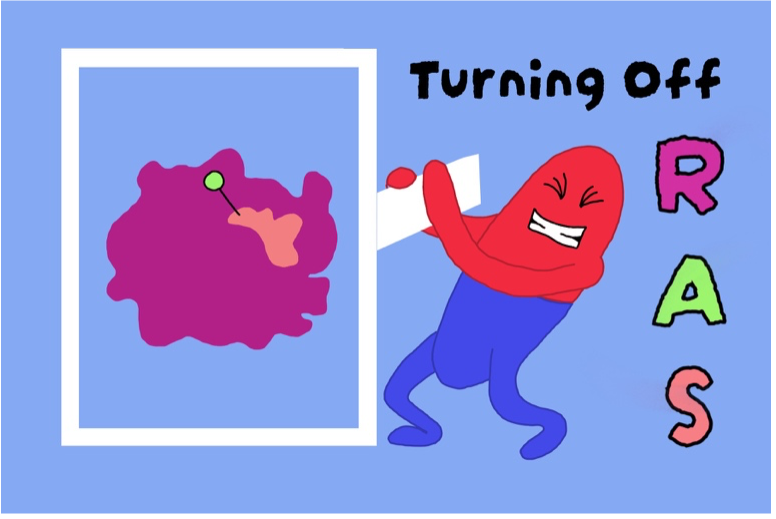
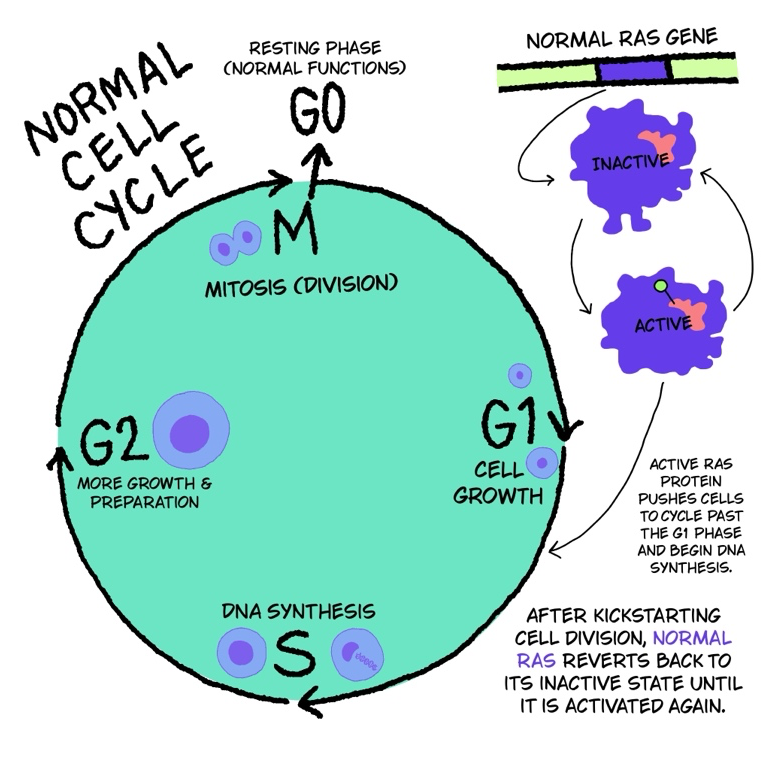
The human body is made up of trillions of cells that grow and divide in a regulated process. When a cell receives a signal to grow, during wound healing or normal development, for example, that signal passes through a relay chain of proteins inside the cell. A crucial link in that chain is RAS, built from instructions encoded in a gene of the same name. The RAS protein acts as a molecular switch: when the cell needs to grow, RAS flips “On.” When growth is no longer needed, it flips back to “Off.” In cancer, mutations in the RAS gene change those instructions and produce a broken switch that gets stuck in the “On” position. Thus, the cells receive an unrelenting growth signal and continue to divide when they shouldn’t, ultimately growing into cancer. Nearly all cases of pancreatic cancer have a mutation in the RAS gene. Since its discovery as a driver of pancreatic cancer, scientists have worked to develop small molecule drugs to directly target RAS to no avail. To circumvent RAS itself, the field focused on inhibiting other proteins that RAS regulates in the RAF-MEK-ERK pathway. However, proper ERK signaling is important to all cells in the body and many of the past attempts to target downstream effectors of RAS have been devastating to the body’s normal function.
New Findings in the Field
For decades, RAS earned a reputation among scientists for being “undruggable.” The RAS protein was too smooth – it seemed to have no surface pockets where a drug could grab hold. From the early 1980s, when Channing Der identified mutant RAS as a driver of cancer, until 2013, every drug that was tested was either toxic or ineffective. During this time, Bryant’s curiosity led her toward a novel line of questions – how did mutated RAS affect cancer metabolism?
Pancreatic cancer cells exhibit increased autophagy – a process in which the cell breaks down and reuses sugars, lipids, and proteins. Bryant hypothesized that mutant RAS was driving the high levels of autophagy. So, she suppressed RAS in cancer cells, expecting to see autophagy decrease. Instead, the opposite happened; suppressing RAS increased autophagy. As Bryant puts it, “This opened up what, over years, became the finding that pancreatic cancer cells upregulate autophagy as a resistance mechanism to RAS pathway inhibition.” When RAS is inhibited, the cells fight to survive by breaking down any spare parts they can find and turning them into energy.
Bryant’s finding eventually led to a clinical trial. There still weren’t any RAS inhibitors available in the clinic, but available inhibitors targeting other RAS pathway members (MEK and ERK) also increased autophagy. By combining MEK/ERK inhibitors with hydroxychloroquine, a drug that inhibits autophagy, researchers hoped to block two methods of cell growth and effectively treat pancreatic cancer. At the same time, two other institutions launched similar clinical trials. Ultimately, all of them failed, showing no improvement over standard treatment and devastating toxicity to patients. Bryant says they now understand what was behind the failure – MEK/ERK inhibitors had strong side effects in patients and hydroxychloroquine wasn’t a strong inhibitor of autophagy in patients – in both cases, it was hard to raise the dosage enough to be effective. Often, what is observed in cells grown in a dish or in laboratory animal models may not translate in humans. So, it was back to the bench.
Back to the Bench
This interplay between bench research and clinical trials is typical and necessary, as Dr. Ashwin Somasundaram can attest. Somasundaram is a medical oncologist who, in addition to treating patients and doing his own research, runs clinical trials through UNC. Phase III clinical trials, which test a drug in a large cohort of patients, regularly run for up to 5 years. And only 30% of the drugs that started a phase I trial make it through to approval after a phase III trial. For the unsuccessful trials, the patient samples that have accrued over 5 years often go back to the lab, where researchers work to understand what went wrong. Why did the treatment work in some patients but not others? What molecular pathways are involved? Is it possible to create cell lines or mouse models to understand the disease better? It’s a long, drawn-out process, and progress can be incremental. But when the process pays off, it has a remarkable impact. Somasundaram points to an ongoing clinical trial at UNC that targets a basal sub-type of pancreatic cancer, an extremely aggressive form of pancreatic cancer that starts resisting standard treatment in 3-5 months. On average, patients pass away in 7-8 months.
Ten years ago, basal sub-type pancreatic cancer would have been grouped in with the overarching umbrella of pancreatic cancer. But over the last 10 years, researchers have gone from simply establishing the existence of this sub-type (as well as other sub-types) to testing out treatments in the clinic. Here at UNC, the labs of Dr. Jen-Jen Yeh and Dr. Gary Johnson identified a protein called EGFR, a known oncogene that functions upstream of the RAS pathway, as a key driver of basal sub-type pancreatic cancer. Yeh’s lab then developed an assay to identify individuals with this particular sub-type. Now, Somasundaram is running a clinical trial to determine whether targeting EGFR can extend the lives of these patients. The trial is still in its early days but there is already reason to hope. One patient initially presented with an inoperable tumor. After joining the trial, their tumor shrank so much that they were eligible for surgery. And when the surgeon operated, the tumor was almost completely gone. Hopefully, there will be more success stories as the trial accrues more patients, but for Somasundaram, even one patient is worth the 10 years of work that led up to this point. “We’re going to hope and pray that it doesn’t come back. But the fact that it was able to shrink to that degree, I think it was quite astounding…the fact that that even changed one person’s life – that is so exciting and rewarding.”
There’s further hope that the availability of RAS inhibitors will revolutionize treatment for pancreatic cancer patients. In May 2026, the results of a phase III clinical trial showed that daraxonrasib, a RAS inhibitor, doubled the median survival of patients with metastatic pancreatic cancer. Somasundaram plans to initiate a new clinical trial combining the EGFR-targeting agent with RAS inhibitors. Bryant’s lab has recently uncovered a new regulator of autophagy called PIKfyve. Between these findings and the RAS inhibitors, Bryant and Somasundaram are cautiously optimistic that there may be a future for another clinical trial targeting RAS and autophagy.
For both Somasundaram and Bryant, the patients are at the center of the work they do. As a physician-scientist, identifying the ways in which his work is going to have the “biggest impact to make patients live longer and ideally, even cure them” is the ultimate goal. While Bryant doesn’t treat patients herself, she regularly invites patients into the lab so that they can learn about the research being done in the field. And the patients are what drive her research forward. “There weren’t more options for [my dad], but there’s going to be more options for future patients.”
Edited by: Tiffany Peters


