 Hazel Milla
Biology, and science more generally, is expansive, encompassing vast bodies of knowledge collected over generations. At times, it’s oversimplified for the sake of breaking down complex issues and making them accessible to learners. For example, the central dogma of molecular biology, which states that information flows from DNA to RNA to proteins, can be a useful starting point when learning about how these different biological materials interact with each other. However, while this way of thinking, also called a paradigm, is a helpful starting point, there are numerous factors that complicate this narrative, like the fact that not all RNA is ultimately converted to proteins and some proteins multiply without DNA or RNA.
While oversimplification can be useful, especially when learning unfamiliar topics, it can become a dangerous pitfall in the context of policy that tangibly affects people’s lives. Often, when proclaimed scientific facts are used to justify a harmful policy, the science is black and white. For example, the claim that there are only two sexes and that these categories are immutable has been used to promote and justify discrimination against gender diverse people (such as those who are transgender, nonbinary, intersex, and gender nonconforming). However, modern scientific viewpoints about sex tend to be more nuanced than this justification. Biologists understand that sex is a complicated phenomenon, with many people falling outside of or within both categories of male and female and/or benefiting from medically and socially traversing these categories, if not stepping outside of them completely. Modern biology tells us that sex and sex characteristics are not strictly binary (meaning they only fall into two categories) but actually fall on a continuum (Figure 1). That isn’t even to mention the added complexity of gender, the psychological and social counterpart to sex, which is frequently conflated with its biological counterpart but encompasses a largely independent set of traits. To illustrate the difference, specific hormones and genes are related to sex while features like clothing and mannerisms can be associated with gender. Gendered traits also vary substantially across cultural and historical contexts.
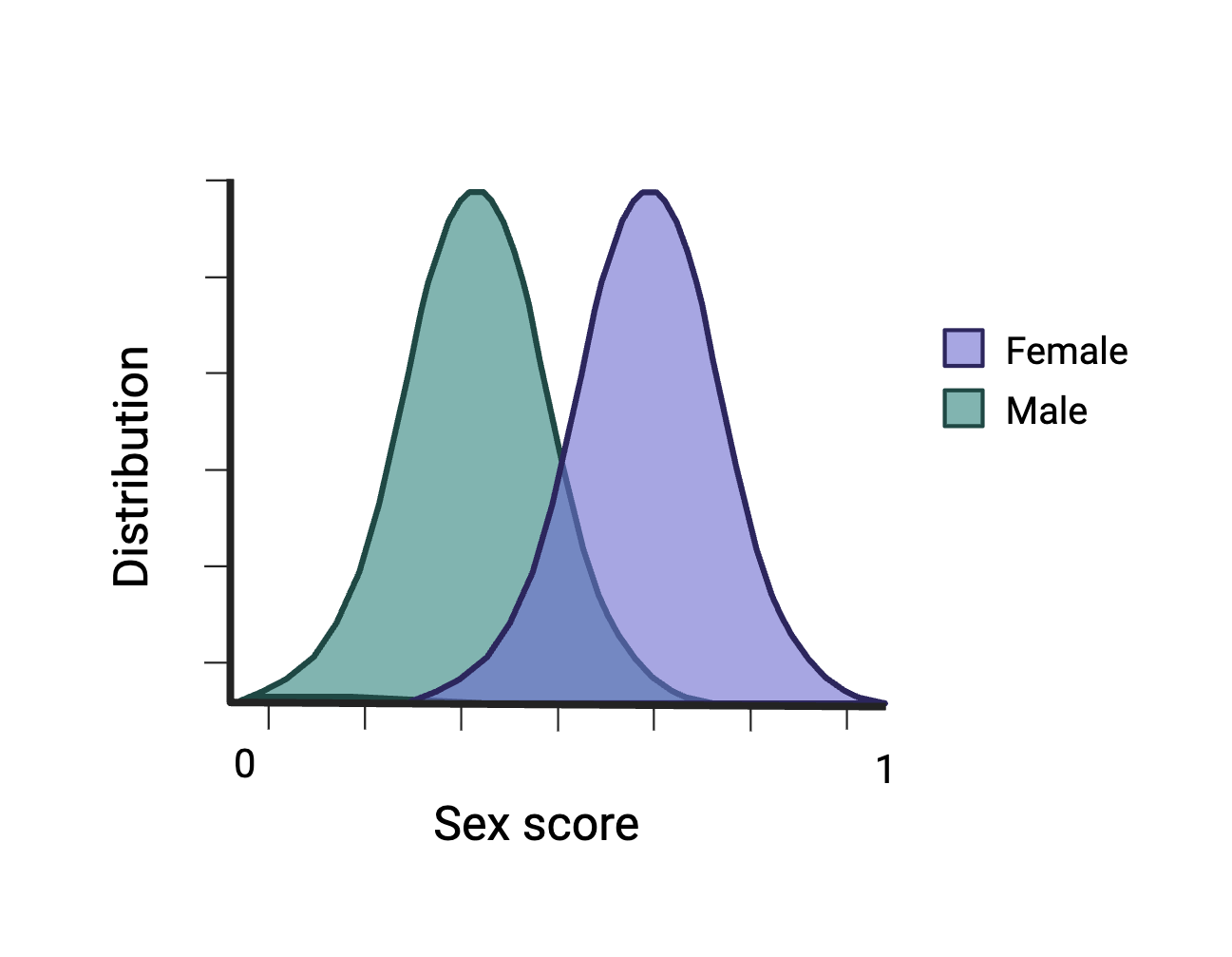
Figure 1. Illustration of sex characteristics as a continuum, with higher scores indicating a trait or set of traits is more female-typical and lower scores indicating they are more male-typical. Graphic created by author using Biorender.
For some analytical purposes, it can be useful to treat sex as a binary variable (i.e., feature used for analysis), such as when conducting public health research and determining if female and male individuals generally have different risk levels for a disease. While this simplification can be helpful for predicting health outcomes, it’s important to know that the biology behind these trends is far from clear-cut and that gender as a social role can also distinctly influence health. (In the realm of public health research, it’s what we call a social determinant of health.)
New discoveries may challenge our existing paradigms about seemingly familiar concepts like sex, such as in the late 19th century, when doctors began to understand that intersex variation was more common than previously thought. For researchers, this complexity is exciting. It can be deeply gratifying to make discoveries that challenge old ways of thinking–it signifies that real intellectual progress is being made. But for political pundits with underlying motives, this complexity interferes with their narratives and is therefore a threat that needs to be ignored, downplayed, or suppressed. A scientifically informed worldview is not threatened by new data and complexity but, rather, is expanded by it. When someone states that sex is binary and immutable, they are not communicating actual scientific information; they are offering a prescription for how the world should be according to their biases.
In addition to myths about biological sex, pseudoscientific narratives about race, autism, vaccines, climate change, and numerous other issues proliferate and are used to justify harmful policy decisions. Science is meant to illuminate, not dictate. It is expansive; discriminatory agendas are not, so it’s essential to be wary of when science is narrowly framed in political conversations. If someone tries to tell you these complex concepts fit an outdated, simplistic mold, it’s worth pondering why they feel the need to adhere to old paradigms while conveniently ignoring updated ones.