 Tiffany Peters
Campbell’s, a company well known for producing easily accessible food, including canned soup, came under fire recently for allegations of the ingredients being bioengineered. An audio clip was leaked where an apparent employee stated that their “3D printed chicken” was “s*** for poor people”. The tone of the recorded statement, allegedly featuring the voice of a company vice president, was certainly derogatory toward low income people, but many responses seen on social media have more to do with outrage at the quality of the food, rather than at the idea that ‘bad’ quality food would be given to the poor. For me, this begs the question: are bioengineered food or genetically modified organisms (GMO) really as villainous as people think?
I wanted to determine the general consensus about bioengineered food. I asked friends, colleagues – anyone who would answer, really – whether or not bioengineered food is safe to eat. I received 25 answers. Given their responses (Figure 1) and the overall reaction on social media to the claim that Campbell’s uses bioengineered food in their products, it seems that the public opinion of GMOs or bioengineered ingredients is at best, mixed, and at worst, wary. According to my survey, 40% of participants thought that these foods are unsafe, while only 16% made an effort to look out for these labels at grocery stores. Of the 12 people that hold degrees more advanced than a bachelors, 58% thought these foods are unsafe, but again only 16% looked out for the labels at the grocer. Note that all degrees are grouped by level, not type (ie. a Juris Doctor, Doctor of Osteopathic Medicine, and Doctor of Philosophy in English Literature are all grouped together.)
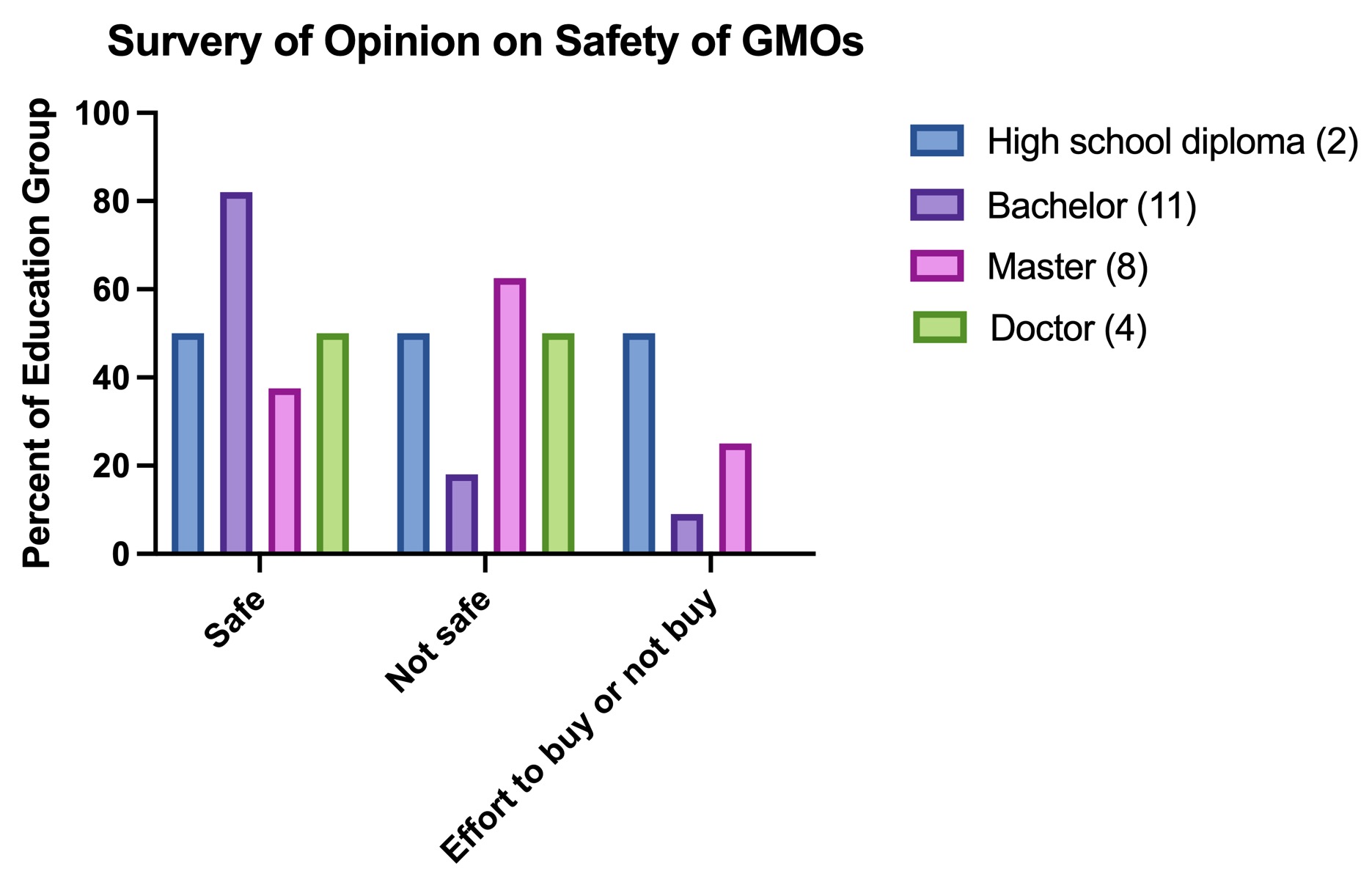
Which of these groups are right – those who chose ‘Safe’ or those who chose ‘Not safe’? To start, we first need to define what GMOs are. According to the National Institutes of Health, GMOs are organisms (plants, microbes) to which we have introduced genetic changes in order to produce a desired trait. This is often done to make the plant more tolerant to disease, weather, chemical treatments, and to produce bigger and better looking crops. This idea was well understood by the participants in the survey when asked if they know what GMOs are. The disconnect between understanding what GMOs are and whether they are safe seems to lie in whether or not they act differently in our bodies than unmodified organisms.
According to the peer-reviewed literature in plant, agricultural, and regulatory journals I perused for this article, consumer safety considerations mostly fall under the categories of compositional analysis and metabolic analysis of the GMOs. This means that the contents of the food (levels and types of proteins, sugars, and other molecules) are measured against a non-GMO counterpart. In particular, they will evaluate the levels of common allergens in GMOs. Metabolic analysis looks at whether those components are broken down or ‘digested’ in the same way when they enter our bodies; metabolite profiles are built and again compared with the most closely related non-GMO. For this herbicide resistant soy plant, metabolites were found to very closely match that of the ‘natural’ product. Environmental safety is also considered where the emphasis is placed on how GMOs affect soil and other crops. In general, GMOs are considered safe when the composition and nutritional value of the food look just like that of the natural product and don’t have detrimental effects on soil and farming. Different countries will set limits for what those margins can be, though there are international regulatory bodies whose research and guidelines serve as the basis for these types of decisions
One other idea that came up when speaking to participants was the idea that the modified genes in crops will lead to changes in our genetic material when we eat them. This article addresses that very question. Genes are not simply ‘incorporated’ upon consumption of genetic material. In fact, the only type of organism that has this explicit function are viruses, whose purpose is to inject its DNA into host cells and have them replicate it. The study by Nawaz et al, which mainly looked at the genetic material of animals that consume feed that is majority GMO, found no evidence of transgenes from the GMOs across the animals’ various cell types. There has been talk about possible microRNA mediated changes in gene expression after consuming GMOs, but the original study suggesting this could not be replicated, and the theory is considered debunked. Some have even pointed to potential contamination in the original study’s samples.

Basic understanding of genetics and the central dogma (Figure 2), the principle that summarizes the flow of genetic information, is accessible to most people in the United States through the public school system. It is also intuited by almost everyone even if they don’t know the name for the phenomenon (or else paternity wouldn’t ever be in question when a baby doesn’t have similar features to the father!). It is well known that genes are shuffled around in every instance of reproduction. So why is it scary when we do it on purpose to make our food supply more robust? After conversations with some of my participants, it seems to come down to mistrust of science conducted by a corporation that they don’t believe has their best interest in mind, and a fear of the unknown involving what the actual process of genetic modification is and what the measurable results are. This kind of fear can be fought with knowledge. It is important to note that peer-reviewed, academic journals like these contain open access articles that are free for everyone to read. And while not all companies involved in agriculture may be transparent, regulatory bodies exist that set standards that they must meet, and the information is accessible to you (here is a database of GMOs in circulation!). If you find yourself worrying about whether or not a product is safe, it’s alright to be skeptical (every good scientist is), but take a few moments to make sure that your opinions are well informed and seek expert advice if you need help interpreting the data presented.
If you’ve gotten to the end of this article, you might be more well informed on GMOs than the average person. So, I want to know: what’s your vote? Leave a comment!
Editors: Abagael Sykes and Emily Hand