 Katie Holmes
Have you ever walked into a room intent on finding a particular item and found yourself suddenly unable to remember what you were looking for? Have you ever sat down to take an exam and encountered a topic you don’t remember covering in class? Has a family member ever recounted a detailed memory about your childhood of which you have no recollection? These are everyday experiences. No matter how good your memory is, most people will find they’ve forgotten something. Our memories are so personal. They construct the very reality we depend on day in and day out, so how and why do we forget them?
The How
Memory: Forgetting’s Necessary Counterpart
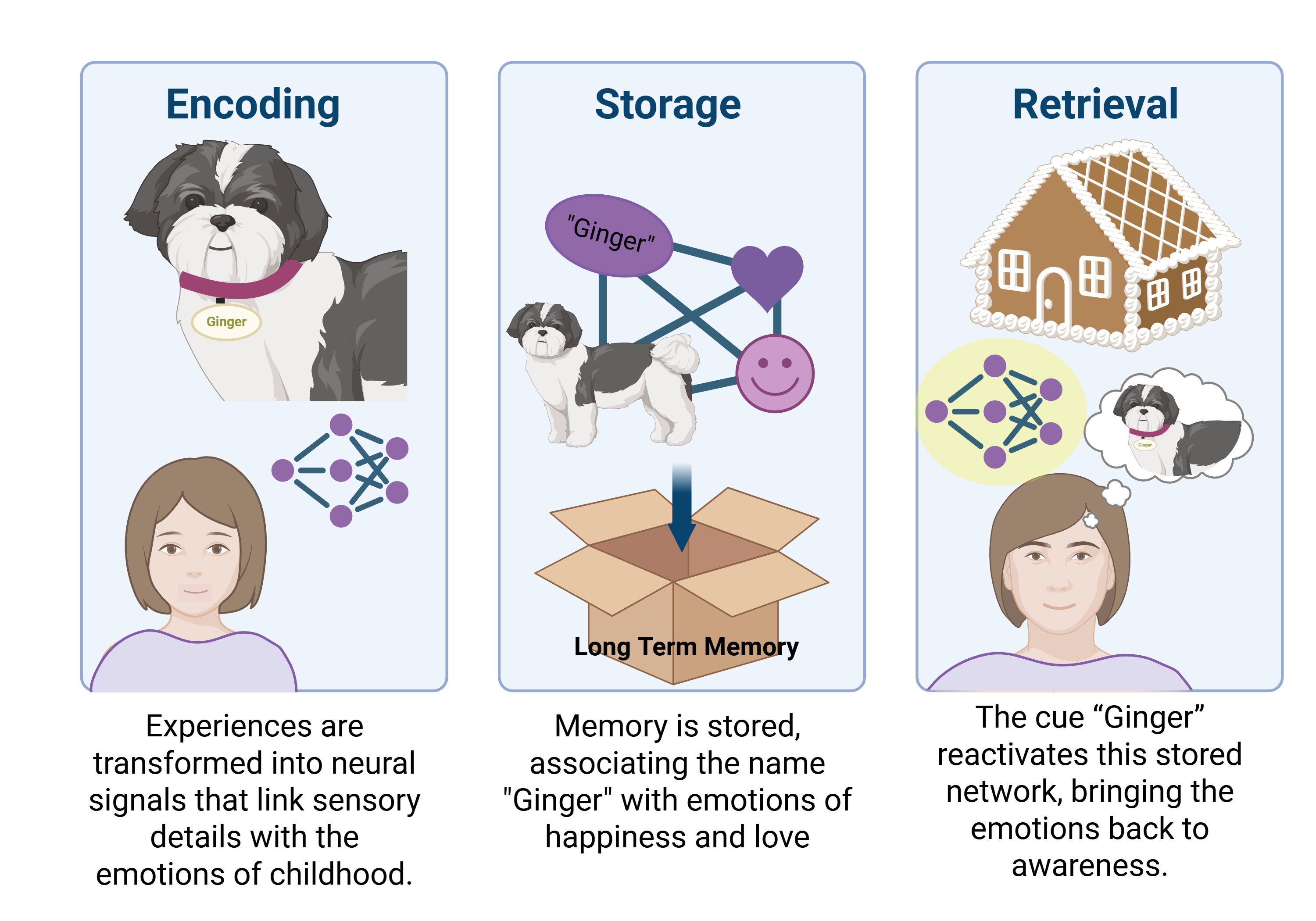
To forget we must first remember. Our memory system includes three basic steps: Encoding, Consolidation, and Retrieval.
Learning, or what experts call encoding, is the process by which our sensory and emotional experience of the world is turned into signaling between cells in the brain called neurons. We experience encoding throughout our lives but it’s most obvious in children as they discover that ice is cold, or that the word “no” is very frustrating. Once encoded, these early and simple discoveries are stored for future reference.
We have two broad types of memory. Our short-term memory – which has a limited capacity and persists for about 30 seconds – relies on persistent signaling between networks of neurons that are encoding an experience. If we want to remember something for longer than 30 seconds, we need to store our experience in long-term memory. Consolidation, the process of memory storage, relies on reinforcing the connections between neurons that are established by encoding. These connections are strengthened and stabilized through repetition. Once our experiences are cellularly stored as a network of neuronal connections, we need to be able to retrieve them. This process requires reactivating the correct network of connected neurons to reproduce the encoded information. Retrieval is often prompted by an internal or external cue. For example, if you’re frustrated with your partner because they neglected to do the dishes last night, you may find that other memories of being frustrated with them resurface. I imagine this is how a disagreement over something as trivial as the dishes escalates into a full-blown fight about your respective contributions to the household chores.
In just three simple steps, our brain interprets, stores, and uses vast quantities and types of information, making memory a profoundly powerful and adaptable tool. The hippocampus, our brain’s memory center, orchestrates much of this process, but it’s not the only region dedicated to the task. Instead, our brain dedicates whole networks that span brain regions to incorporate elements of our sensory experiences, emotional interpretations, and even our instincts into our memories. These interconnected networks turn our memories into a rich archive of our lived experiences, and this archive has a fundamental purpose: to make past experiences useful. Memory is how we use past experiences to inform our present reality and guide our future behavior, but we don’t hold on to memories forever. Most of what we know is eventually forgotten.
The Mechanisms of Forgetting
At its core, forgetting is the routine breakdown of our memories. As covered above, memories are formed in three steps: encoding, consolidation and retrieval. But which of these processes breaks down when we forget? Once we learn something, do the neural networks supporting our memories degrade over time, limiting our ability to store information? Or is forgetting the result of changes in our ability to access the memories we’ve formed? In short, does forgetting stem from problems consolidating or retrieving the information we’ve encoded?
The short answer to this question is that it depends on what’s being forgotten. We forget all sorts of things, ranging from why we walked from the kitchen to the bedroom, to the field trip we took to the zoo in kindergarten. We use the same verb to describe these two experiences, but cognitively they are very different. These experiences occur on vastly different timescales. We can forget both short-term and long-term memories, and even within our stored memories there are different kinds of forgetting.
There are two theories for how we forget short-term memories. The first, called Trace Decay Theory, is that these transient memories decay after a certain period of time. Short-term memories rely on sustained signaling between connected neurons, once this signaling stops, the memory fades. The second, called Displacement Theory, suggests that our short-term memory gets full, and new information displaces the old over time. These theories seem to explain most of my personal experience with forgetting short-term memories. If I forget what I walked to the bedroom to grab, odds are I either waited too long before going to get it or got distracted on the way.
Within our long-term or stored memories, there are also different types of forgetting. Have you ever been watching a movie and suddenly seen or heard an actress that you swear you know but you can’t think of her name? This “feeling of knowing” is a distinct type of forgetting characterized by the failure to retrieve a memory that you can usually access easily. As touched on above, retrieving memories requires a cue. These cues can be many different things, but experts seem to agree that we remember best when the cue triggering the memory matches the one present at encoding. So the next time you can’t remember an actress’s name, try remembering the movie you first saw her in. That cue alone may jog your memory.
In addition to this momentary forgetting of long-term memories, there are plenty of “weak”memories we make that just fade. Every time I read a detective novel and the Agatha-Christie-inspired inspector is probing suspects for where they were last Tuesday at 4:23pm, I think “there is absolutely no way I would remember that.” This is true for most of us. The mundane details of daily life — like what you had for breakfast, the precise minute you got to work, or how long your commute took — are quickly forgotten. Evidence suggests that these kinds of details become very difficult to recall after about 24 hours. For a long time, it was thought that these were a kind of short-term memory that never really gets stored, but an experiment in mice recently showed that these memories can resurface with external electrical stimulation. This result suggests that these “weak” memories are stored, but fade because they are rarely strengthened by retrieval.
Forgetting an actress’s name momentarily and forgetting where you were last Tuesday at 4:23pm both result from failing to retrieve the relevant memory. But, has your mom ever recounted a vivid memory of a specific trip to the science museum when you were 10 that you have absolutely no memory of? Mechanisms of forgetting that target successfully stored and strengthened memories, like the trip to the science museum, involve changes to the network of neurons that encode that memory. These networks routinely change in response to daily experiences, novel stimuli and emotions (like trauma), and injury. Remodeling these networks either through the birth of new neurons or by changing the connections between existing neurons can make them harder to access or even entirely irretrievable.
Summary: Use it, or Lose it
Our memory system is like an email client with infinite storage and a software that automatically prioritizes your messages. New messages and things you revisit are the highest priority and remain instantly accessible. Everything else is thrown into a vast searchable archive which uses thoughts, feelings, sounds, and smells to call up messages on demand. Messages are rarely deleted, merely adaptively reprioritized to better reflect how you use them. All I can say is that the day someone develops a system this elegant to organize my email will be a very happy day.
The Why
A mentor of mine once told me that natural scientists, like chemists, biologists, and physicists, don’t ask questions that start with “Why?”. We are apparently supposed to focus on “How?” questions and leave the “Why?” to social scientists like psychologists, philosophers, and economists. However, the answer to why we forget may have a scientific, or at least an evolutionary, answer.
The Brain’s Limits
The human brain is often compared to a computer, but this isn’t the most accurate analogy. Computers are very rigid — our brains, in contrast, are extremely adaptable. Computers have limited processing power and storage capacity, but your brain isn’t functionally limited by either. The connections between neurons in your brain could theoretically hold about 2.5 petabytes of data which is a few hundred years worth of memories. If forgetting isn’t required due to the constraints of physical brain space, why risk losing information you might need?
Evolutionarily, losing some information must be advantageous, so let’s back up a bit to reflect on the advantages of remembering. Remembering allows all sorts of useful behaviors that bias our odds in favor of survival. For example, imagine that you saw a pack of wolves gather by the river. We can learn from that encounter, remember it the next time we’re in the area, and decide to avoid the river. This ability to act on encoded information is very useful — until the wolves leave. Once they leave, we don’t want the pack of wolves to keep influencing our decision-making.
Somewhere along the course of evolution, the brain had to make a tradeoff. It traded remembering every precise detail for improving memory-guided decision-making by continually updating the impression of reality encoded in its memories. If our brains stagnantly remembered everything, we would be making decisions based on outdated information. And so, the brain adapted to forget.
The Conscious Mind…Forgets
Forgetting is adaptive. Nothing illustrates this point better than listening to the experiences of individuals with Highly Superior Autobiographical Memory (HSAM). Individuals with HSAM can recall details like the date and time of every single doctor’s appointment in their calendar. This kind of memory conveys certain advantages including an encyclopedic knowledge of the topics that most interest you. But, it comes at a massive cost. Most individuals with HSAM report that their unrelenting memory makes living with grief, pain, and trauma almost impossible. “You feel the same emotions – it is just as raw, just as fresh…It is like having these open wounds – they are just a part of you.” Most of us can relate to this feeling, but our emotional wounds scar over time. We forget the worst of what life throws our way and for that, I am grateful.
Our balanced system of forming and forgetting memories guides our decision making and blurs the most painful elements of our past. As a result, it is inextricably linked to our consciousness. Our memory system gives us the ability to recall individual events and facts, but our consciousness binds these disparate memories together to form the narrative on which our reality and sense of self are built. Our memories change: they are continually updated to reflect our novel experiences and environments. We are updated with them. We tend to believe that we aren’t capable of this kind of change, but this couldn’t be further from the truth. This capacity to change is quite literally built into our brains because we forget.
Editors: Julia Drennan and Lauren Griffith
Illustrator: Claire Miller
